Writing the Body of the Book

Every morning I brew Folgers-nothing-fancy in my headboard bookcase so that I can begin writing fresh from my dreams. Pajamas or nearly naked, depending on the season. Darkness or daylight, depending on the moon. Before I feed my dog and cats. Before I rummage in the pantry for breakfast in bed. Before the bald eagle flies low over the water outside my window… and he just this moment did...right on schedule. The white of his head and tail feathers so purely bright bright bright. I sigh. Every time.

For the past five weeks, I have written nothing new, other than a few watered down Facebook posts and I’ve not shared the reason. Till now.
At some point a writer needs to leave one’s nest and face criticism. Critique criticism, not you-bad-bad-girl criticism.

During the summer, I subscribed to Lidia Yuknavitch’s mailing list and, heck—I couldn’t believe it—that very same day I received a message that applications were open for her The Body of the Book workshop, where eight writers with unpublished manuscripts would meet for twelve Tuesday evenings to provide feedback and support. Not trite feedback-and-support but real, committed, feedback-that-feeds-support.

Omigosh. I began work on my application immediately. Cut to the chase. I was accepted.

I’ve been taking the train to Portland every Tuesday, booking into a wonderful little hotel that began as a sailors’ lodge in 1881. I’m loving the fifty-bucks-a-night coed hostel-style bunkroom. On the first day, the twenty-something clerk asked if I wanted her to show me how the key card worked. (WTF. Exclamation point. Yeah. I blanched. I blinked. But I simply said “no”. Ageism?? God bless me when I finally let my hair go grey. But nevermind. It’s a great place and at some point I guess I have to share that our brain cells don’t blink out like fireflies once we turn 65.)

The class is all positive good stuff, all inspiration, all writerly comradery. Warm, hot, winey, and most of all, a safe space and politics aside, although we all share the same politics. Politics: the process of making decisions applying to all members of each group.

When we were accepted, we committed to bringing everything we’ve got to the other members in the group. Feedback and opportunity. Ninety new pages to think hard on each week. Pure responses.

So that’s what I’ve been up to.

We’re midway through the process.

I’m going to miss these brilliant woman and their stories when it’s over, but for now, I’m going to continue to respond with the same fervor that I appreciate from others.

As if that isn’t enough good stuff, it’s harvest season. When I return home, it’s blackberry jam, pickled beets, zucchini relish, homemade blackberry brandy fermenting in the downstairs closet, tomato sauce simmering on the stove, a lovely chunk of brisket brining in the refrigerator for my homemade pastrami.

It doesn’t get any better. Growing, nurturing and harvesting stories. Feeding our souls and our bodies.

 

Follow me on Facebook.

Thanks!

Willpower

Willpower is not my strong suit. It’s not my weakest weakness, but I could do better. What are the biggest weaknesses in my willpower folder?

Writing and Reading.

Writing should not be an issue for a writer. When I get these ideas in the middle of the night, when I awaken with my teeth clenched in my mouthguard and my eye mask askew, my hands shaking with the visage of the ethereal nightmare that I’m watching grow smaller and smaller as it drifts out the window, lifting up into the naked branches of the cherry tree, and beyond, into the clear clear clear dark sky, I reach for my laptop.

I open a Word doc and type the sentence I want to remember, the sentence that will fuel my message later. Much later. I have too many writing prompts on too many topics.

But Reading. That’s my biggest downfall, my Achilles’ heel.

I am constantly finding one thing after the other to read online! (Exclamation points are another weakness but I have almost conquered that one, and you’ll note that the previous exclamation point is warranted!.)

“The anatomical basis of Achilles’s death is more likely to have been injury to his posterior tibial artery behind the medial malleolus, in between the tendons of the flexor digitorum longus and the posterior tibial vein. This area would have been included in Thetis‘s grip.” See what I mean? I’m pathetic.
The New Yorker tells me that I’ve hit the wall. I’ve read all the free articles they’re going to allow me. “Subscribe for $1 a week and get a tote.” I have too many totes, but I very nearly do it. I fear that if I subscribe to one, the rest will follow like literary dominoes. The Wall St. Journal, The Washington Post. Like the 12 Temptations of Christ, they’re calling out to me from their individual browser windows until I have filled way too many hours of my day with an endless loop of reading.

The New York Times is a deep bottomless pit of content. Yes, I do subscribe to The New York Times, digital edition, so it’s my own fault. I had been a faithful print subscriber to The Wall Street Journal for years, and then, damn it, the he/she faceless, anonymous paper delivery person kept forgetting (even when I left notes) that on Wednesdays, if he/she left my Wall St. Journal in the Beachcomber tube, the weekly Beachcomber would not be delivered. They penalize us like that. (Fair enough.)

I finally had enough of occasionally missing out on Wednesday’s local news, obits and the Calendar. I called The Wall St. Journal and told the man in India about the tube that the he/she, faceless, anonymous paper delivery person was hijacking everyday and, with unfortunate results, on Wednesday’s. “I would like to cancel my subscription.”

I would miss Dan Neil, the automotive columnist, whose blend of wit and mechanical knowledge is quite attractive to me. I wouldn’t miss the $5000 Gucci handbags in the monthly magazine section. I wouldn’t miss the Financial pages because I never read the Financial pages. I wouldn’t miss that humor guy whose pieces appear in the lower right spread “below the fold” on the Opinion page. (Below the fold is where they put the lesser content.) I can’t remember his name, but I sincerely believe that I could write a humor piece as good as he. (And don’t tell me it’s “as good as him”. When did the world switch from “he” to “him” in this context? It’s everywhere. Don’t they read Grammar Girl?)

Here I go again, off an another reading tangent. I googled* “Wall St Journal opinion page humorist” and after Peggy Noonan (!) I find a list of Top Humorists. Stephen King is #1 on this list. Joan Collins is #3. What? Art Buchwald, my childhood idol (You think I’m joking?) is #7. Tsk.

The man in India asked if I would keep my subscription if he directed the he/she, faceless, anonymous paper delivery person to install a proper tube for The Wall St. Journal. Like a good customer service rep, he diffused my annoyance and I agreed to allow 2 weeks for the tube to be installed.

I waited 4 weeks. Still no tube, and yet another lost Beachcomber issue. I called and there was no distracting me this time. I cancelled my subscription and went online to subscribe to The New York Times. I’m sure that Rupert Murdoch is not going to miss my $99 per half year.

Now I’m reading a whole new litany of favorite columns. Modern Love is best. I crave warmth like the Pillsbury Doughboy.

Facebook is my love/hate relationship. Why does someone have to ask a question of their readers that I feel responsible to answer?

This morning a fellow writer, a friend, who is writing a novel set in the time of Boccacio, posted “Who can tell me what the paste left after the oil is pressed from olives is called in Italian? In medieval times, it was a treatment for arthritis and joint pain.”

I responded,
“No, I cannot. However, thanks to your question and my lack of self-control with Google, I now know more than I need to about olives— production, harvest and economics!”

I’m incorrigible.

I found a solution to my lack of willpower with respect to Reading online.

I decided that, beginning today, I shall unplug my laptop when I begin to read online. When the power percentage reaches 0% and my MacBook powers down, that’s it. Tough luck. I’ll have to proceed to the items on my “To Do” list.

Did it work? No. As soon as the pop-up warned me that I was at 5%, I ran for the charger. I needed to finish “How Weed Got Me in the Best Shape of My Life”. What? I don’t need weed to exercise. But I was curious. This is Washington state, after all.

I should note that the day after I cancelled my Wall St. Journal subscription, I found that a shiny new Wall St. Journal tube was in place at the end of my driveway with the morning’s issue.

The very next day, it was unceremoniously removed.


*Is the verb “google” upper case or lower case? When I google it, I get everything to do with the search engine and nothing to do with the verb. 😉

Like me on Facebook.

Read more stuff.

Anticipation. In the garden and in Life.

I’ve been watching the fruit and vegetables in the garden grow and mature. Weeding, watering and wondering. When exactly is the first tomato going to be perfectly ripe for the picking?

Anticipation, I’ve always said, is a big part of any experience whether it be harvest or travel or concert or film or other highly anticipated event. The days creep along, the calendar dates change slowly. Finally, the day arrives.

Last week, a few tomatoes began to ripen in earnest. Pale orange became pale pink became reddish became almost red but not quite true ripe juicy red. I wandered around the plants, lifting a leaf here and there. I wondered which tomato would be first.

The Early Girl plants are massive, the Jet Stars half their size. Pacific Potager, where I bought plants this year, had at least three dozen varieties of tomato plants to choose from. This being only my third summer in the Pacific Northwest, I was uncertain of which to try, so reliable Early Girl was my first choice. I chose Jet Star plants because they were sturdy with a maturity date several days beyond than the Early Girls.

Surprisingly, when it came right down to it on Thursday afternoon, it was a Jet Star that would prevail.

I was harvesting parsley in the shade of our wisteria-covered pergola. Had pulled up the plants, roots and all. Rinsed off the roots with the garden hose and was snipping the parsley off the stems into a tub in preparation for chopping in the food processor before filing away in the freezer.

After a half hour of snipping, I was ready for a snack and remembered that it might be time for First Tomato.

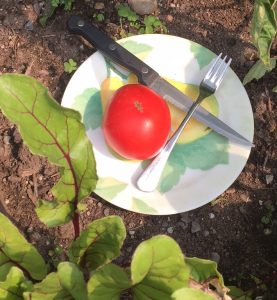
A few steps away, there she was. Bright red, perfectly red and ready. I tenderly removed the tomato and placed it on a plate. “Tenderly”?

Yes. This was no grocery store tomato, not even a farmer’s market tomato, but a tomato to be consumed in the garden, minutes after picking.

Returning to the pergola table, I slowly drew my knife through its center, the fruit yielding perfectly to the bite of the serrated blade. I cut again, and again, until the tomato lay before me in perfect bite-sized unadorned fragments. Twenty of them. I took the time to count.

Is this beginning to sound obsessive-compulsive?

It was pure anticipation and enjoyment and I was delaying consumption as long as I could.

I sprinkled black pepper and then ground a few twists of pink Himalayan salt, watching the salt dissolve as it landed on the wet surfaces.

Then, the fork. The first taste, the flavor.

Jet Star Tomato

First tomato of the season

I spent a good fifteen minutes enjoying that tomato, while thinking about how I need to cherish more moments like this with pure anticipation and enjoyment.

What’s your tomato today?


Follow me on Facebook.

The Time is Ripe.


Unexpected Triggers

Yesterday, Janet brought me a freshly-picked bouquet of August blooms accented with curly-topped white phlox. They were just like the phlox that were as tall as I in the days when I ran barefoot in dewy cool green grass. I was 3 or 4 years old in that memory and my grandmother’s phlox border must have been about thirty feet long. It stretched the length of our tractor garage from the tool shed to the outhouse.

Vivid blue-violet salvia, the spiky perennial kind, sturdy-stalked and long-lived, stood out boldly, almost dominating the three velvety stalks of gladiolus that completed the arrangement. I placed them in the middle of the coffee table and examined the gladiolus more closely.

They were a color that I’m still challenged to describe—somewhere near coral but pinker and not quite red. These sweet gladiolus were the trigger.

How could I have forgotten about my mother’s love of gladiolus?

Gladiolus were always prominent in the displays on the altar at St. Joseph’s when I was growing up. After Mass, my mother would coo over the gladiolus.

“Did you see the red and yellow gladiolus? Ohhh, they’re so beautiful…”

You may know that gladiolus are grown mostly for cutting.

My mother, however, never cut a single stem of hers.

The reason was that my father would not allow fresh flowers in our house (except for lilacs which he had grown up with). He despised the fragrance of fresh flowers and said that they made the house smell like a funeral parlor.

Maybe it was the metamorphosis of soft vulnerable petals to dry and withered remains that offended him. Acceptance of his mortality had never come easily.

My mother would not be discouraged. She planted her beloved gladiolus in a long, straight row, five inches apart like it said on the bulb package, next to the Tenderpod green beans. She would walk in the vegetable garden after supper in August, and given the alternative, she was content to admire her gladiolus next to the green beans.

In the house, she placed a bouquet of plastic flowers in a cheap cut-glass vase on top of the TV. They couldn’t come close to standing in for flowers sprung from the soil, rained on by spring showers, and coaxed open by summer sunshine. These plastic flowers would never die, even though they faded to pale ghostly shadows in the window’s bright light.

Eventually, silk flowers were invented, and my mother tossed the dusty plastic flowers, replacing them with silk roses, red as the ones lovers send on Valentine’s Day, flowers that my mother never received.

The years passed and soon my father was at the end of his days, under hospice care at home, a hospital bed installed in their living room. When my mother found him dead, she refused to unplug his oxygen until the first responders came to take on the task.

The next day, she awakened and went into the living room. She swears that one of the roses red as a lover’s valentine had popped up from the bouquet during the night. She says she found it sticking out five inches above the rest and is convinced to this day that my father was sending her a message from the other side.

And while I do believe in ghosts and I do believe in miracles, and in lovers bringing red roses, I’m not sure that I can believe in this particular ghostly miracle.


gladiolusFollow me on Facebook. I can always use a few more friends.

Maslow Meets Fear

Three days ago, I posted about the fear of tap dancing.

Well, there was a little more to it than that, but fear and hesitation pretty much sum it up.

Received an email newsletter this morning from Holstee, with its editorial written by one of Holstee’s two brother founders.

He referenced the psychologist Abraham Maslow as he spoke of a recent episode of his own fear, a backflip into a canal in Amsterdam. Do it. Don’t do it.

I had totally forgotten about Maslow (Psych 101). His theory is a perfect reference to the tap dancing post. That is:

Maslow said that at any given moment we can step forward into growth or step backward into safety.

It’s as simple as that.

If you choose growth over safety, it’s so worth it.

What’s your precipice?

fear


fear

Follow me on Facebook. I could use a few more friends. 😉

The Easy Way Out?

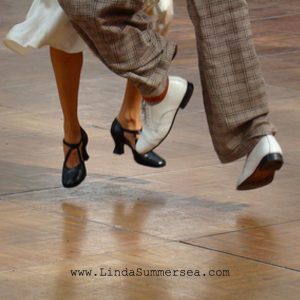
This summer, I’m taking a series of twelve tap dancing classes for adults at our local arts center. It was a last minute decision. I saw an ad in the local newspaper that triggered one my childhood desires.

Remember Shirley Temple and Bojangles tap dancing up and down that steep flight of stairs? Shirley’s banana curls bobbed up and down while the tails of Bojangles’ morning coat fluttered with the movement of his feet.

When I was five, I had the banana curls, but I never got the tap dancing lessons, so I thought, “Why not?”

The concentration required for tap dancing might be a good exercise for my brain, especially since I’m somewhat rhythm-challenged. Anyway, that was my excuse, and it turns out that tap dancing is a good brain exercise. Like rubbing your belly and patting your head at the same time.

As soon as I registered for the class, I ordered my black tap dancing shoes. Amazon Prime.

And before the UPS man was even out of the driveway, I was lacing them on in the front hall. I walked across the tile floor. Click, clack, click, clack. Then across the hardwood. Click, clack, click, clack. Out the back door. Click, clack, click, clack. Across the wooden deck…

Suddenly I knew why those boys in junior high had cleats attached to the heels of their shoes. What a cool sound!

Our dance instructor says that tap dancing is making music with your feet.

I never thought of it that way, but now walking to the refrigerator for a handful of cherries has taken on new meaning. Suddenly it’s fun, clickety-clack, clickety-clack. Toe, toe, heel, heel. Stomp, step, brush, step.

As our instructor introduces new combinations of steps, I’m willing my feet to follow my brain, and soon I’m tapping a little faster, and faster still, as the lessons progress. I’m even managing to keep up with the midriff-baring, college-age females in the class. Just barely.

Our teacher says we’re doing really great and so she’s pushing ahead of the lesson plans.

That doesn’t stop me from having my doubts. I practice indoors and out with my tap dancing cheat sheet in one hand and my other hand extended  for balance. Toe, toe, heel, heel. Dig, spank, step, heel.

At home, without the distractions of ten other pairs of feet clacking next to me, and without the rafter-raising volume of Billie Jean pulsing to my core, I’m doing quite well. I’m surprising myself.

Then I set out for class and—like clockwork—about half way through the session, I get a wave of self doubt and my smile fades.

Am I ever going to be able to connect the movements on my own without someone calling out the steps? Maybe I shouldn’t have signed up for this. It was a dumb idea. How do four-year-olds even do this?

I’m going to tell the instructor that the tap dancing is stirring up an old knee injury. Or maybe I’m getting shin splints. I have a stomach ache. I have to be somewhere else. That’s it. I have an appointment that I forgot about.

Just as suddenly as the hesitation appears—every single week—I figuratively slap myself and carry on. I put the smile back, and concentrate harder. The music is fun, after all, and the clickity-clack feels good. And the sweat! The back of my neck doesn’t feel too pretty. Hot now. Summer in the city.

I realize that maybe it’s because tap dancing is not easy for me. I’m not in the habit of selecting really challenging activities as recreation. I know the things that I’m good at, and those are the things that have become my hobbies.  Isn’t the point of recreation to have fun?

This tap dancing thing is a good lesson for me. I’m showing myself that if I stick with something that’s not easy, maybe I’ll be better prepared mentally when I need to hang in there through a challenging life experience.

Clickety-clack. Brush, spank, hop, step. Dig, spank, step, heel.

And repeat.


tap dancing  Follow me on Facebook.tap dancing

Subscribe to my Blog. No spam. Your info never shared.

Inspired by The New Yorker. Writer needs forever home. Adoption listing.

Linda Summersea May 2016Meet Linda. She came to us with a BFA and MFA, but sadly, these degrees were not in Creative Writing. Her shame for advanced degrees in a field outside of writing has left her cowering in self-doubt but she no longer piddles when addressed in a loud voice and rarely bites back—providing she is given lots of affection. As she is of advanced age, we have been having a difficult time placing her in a tolerant environment where she can thrive. Although easily distracted Linda can be kept on task with black coffee and BoomChickaPop. She benefits from a long walk every day, preferably in the shade of a forest with someone who is open to discussing writing prompts. In the past, Linda has run off to foreign countries without warning and been difficult to locate. She has recently been micro-chipped. Problem solved. Linda’s current wardrobe is almost entirely black, but since she responds well to tie-dyed garments, we’re hoping to add other colored garments in the near future. Linda would do best in a one-writer home with access to a hot tub.

I wish I could say that the topic of writer-as-pet-needing-forever-home was my own brilliant idea. Alas, Sarah Hutto beat me to it. Read her hysterical piece Writers Looking for Forever Homes here in The New Yorker. And thanks to Seattle writer Camela Thompson for the heads up. It made my day. Still laughing.

Are you a writer? Surely you are now opening a Word doc to pen your own adoption listing.


New YorkerFollow me on Facebook or I’ll bite you.

Meditation on One’s Calling

Clearly, for me, May has been a month of false starts and unfinished business, crossroads, and decision-making. Let’s try this blog post again. 🙂


Every Friday morning, I park my vehicle under a large Kwanzan cherry tree in a parking lot a couple blocks away from the Senior Center. With its fragrant double blossoms, it’s the kind of exemplary cherry tree that we associate with cherry blossom festivals in the Spring.

Two weeks ago its petals were drifting down to the pavement in flurries so thick it was accumulating like snow. Moist and slippery. And beautiful.

I was on my way to my weekly Guided Meditation Class.

I was thinking about earth—dirt, soil, compost, all of the above. I had spent a month that was more outdoors than in. I had been walking the earth, digging in the earth and thinking about digging in the earth, in the sun and in the shade, in the brutal heat and the cool rain.

#

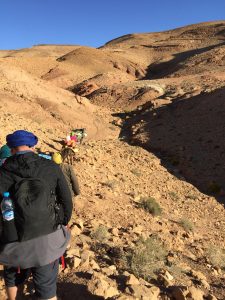
I had begun April walking with Berber nomads from the desert plains to the Atlas mountains of Morocco, where the earth and the air were dry as toast. For a week, our international group of twelve were an active part of the nomadic experience 24/7.

Atlas Mountains, Morocco, April 2017.


No running water save for one lively spring that poured  from a crack in the upthrust rocks on day 2. No conveniences of any sort, and millions—billions—of brilliant pinpricks of stars above by the time I slid into my sleeping bag in a new location each night. Intimately connected to the earth, with only the occasional bleating of sheep and goats breaking the silence.

When I returned, I spent a week transitioning back to modern life and crawling around in my damp gardens, thinning, transplanting, and weeding in preparation for another couple of weeks away in the outdoors.

I set out again, hiking the woods and hills in the Berkshires Mountains of western Massachusetts, enjoying “carpe diem” moments to continue the hiking momentum that had dominated my days in North Africa. Again, I hiked for hours without even noticing the time.

I found myself drawn to the trails where my literary heroes had walked, some of these trails now part of the Appalachian Trail. Went to the farm of Herman Melville and walked in his woods, climbing over fallen trees, and standing beside gardens that were still half-asleep after a long, stormy winter.

On one particularly unseasonably warm day, I climbed Monument Mountain where Melville and his friends had enjoyed these same views after a sweaty hike through mature deciduous woods scattered with the rocky remains of boulders tossed there during the Ice Age ten-thousand years ago.

Drove down to Amherst to Emily Dickinson’s home. Looked out the window from her second-floor bedroom, more gardens, more inspiration.

#

All of those experiences were uppermost in my mind on my way to meditation class that Friday morning.

Our theme that day: What do I have that I can share with the world?

We began with deep breaths in and deep breaths out. 4 seconds in, 4 seconds out. Belly breaths. By the time we reached the completion of our meditation, I was 8 seconds in, 11 seconds out. A new level of relaxation for me.

When I opened my eyes, I had my answer to the theme.

#

“Sharing my truth” is my answer. It’s been my goal for the past few years. I had dug deep into shrouded memories to write my childhood memoir after a long career as a teacher. I thought those years of teaching had (almost) been fruitless. I knew I had affected lives here and there, as most teachers do, and I had felt the reciprocal effects of my students’ lives as they taught me their life lessons. But teaching was not the career I had longed for as a child. I wanted to write, and it was a great relief when I realized later in life that it wasn’t too late.

#

Two days ago, our meditation theme was a variation on our earlier “sharing”.  What was “our purpose” or “our calling”in life?

Suddenly I remembered the words of a school principal during one of my annual job assessments. She told me that true teachers are born, not made, and that I was a natural-born teacher.

During Friday’s meditation, those words suddenly came back to me and I understood that all those years of teaching were not for naught.

I now see that there’s a connection between my previous life’s work and my current life’s work. With my writing, I hope to, want to, will continue to teach, but on a different scale and in a different format. No longer one to one, or one to thirty, writing has the ability to be one to infinity. As a writer, our work and inspiration can carry on long after we are gone.

What is your calling? your purpose?


meditating, meditation

Follow me on Facebook.

American Writers Museum

american writers museumToday is opening day at The American Writers Museum in Chicago IL.

Actually I didn’t even know that it was being assembled until page A13 in this morning’s Wall Street Journal.

According to the review by Edward Rothstein (Critic At Large), the AWM has been created at a “sensible” cost of under $10 million: its 11,000 sq. ft. are housed on the second floor of an office building at 180 N. Michigan Avenue, Chicago, IL 60601.

Since I haven’t visited, I can’t very well make this a review within a review, but I do think the concept of a writers museum sounds pretty admirable. Of course, as a writer myself, I found myself questioning the punctuation of its name. Should it be American Writers’ (possessive apostrophe) Museum?

No, I guess not. It’s not owned by writers, they don’t possess it, so it can hardly be possessive. It’s not even for writers, as one doesn’t go there to learn writing. It’s best described as a museum for readers (Rothstein says that “an earlier era’s powerful American writers’ museums were called libraries.”)

Mr. Rothstein, for the record, says “I wanted to like the result much more than I actually do.” The fact that his review is entitled “A Cliffs Notes Approach to Literature” hints at his opinion so I dug in. The accompanying WSJ image shows The American Voices exhibit of 100 (dead) writers. Rothstein finds a lot to critique/criticize.

Again, I’ll not quote his lukewarm response to the finished result. It seems to me that his review hints at his personal dilemma. He weighs the better and lesser points of the museum. I could picture him walking around saying “…hmm.” On the plus side, Rothstein does say that the AWM was “put together with care and designed with panache by Andrew Anway”. And FYI, The American Writer Museum is “the brainchild of Malcolm O’Hagan, a retired engineer who, after seeing the Dublin Writers Museum, was determined to build one like it here.”

I could say something about Americans not revering their writers quite as much as the Irish. However, that might be debatable.

After reading the Rothstein review, I sought out the AWM website. They have a lot to share at the museum, and a lot of it is interactive.  There are a many events lined up, including writer readings and signings. Ha! I guess we all know what the newest writer coup will be.

My favorite page is their Affiliates list: The Museums/Writer Homes officially affiliated with them. A long list is it. A bucket list, to be sure.

My second favorite is the home page because my favorite deceased author, Herman Melville, is featured dead center—I mean, “front and center”.

Checking out some other reviews online:

Amy Diegelman for BookRiot calls it “Chicago’s New Literary Paradise”.

The Chicago Tribune’s reporter Steve Johnson calls it “far-reaching, dramatic”.

The Washington Independent Review of Books tells the story of the museum’s inception in this 2012 article.

It’ll be a while before I get to Chicago. In the meantime, if you visit The American Writers Museum, we’d love to have you share your impression here.


american writer museumI’d love it if you’ll follow me on Facebook.

C’mon, you know you want to. 😉

International Women’s Day

Today is International Women’s Day.

International Women’s Day was originally International Women’s Work Day. So I mused about whether I should write about feminism in the workplace, or the role of women in the world, or simply, as smart and outspoken writer #MaryKarr posted this morning: “hope folks wind up grateful for unpaid butt wiping & food prep & the oft-underpaid female.”

“Feminism and basic equality for women”

international women's dayThat’s what I can relate to most, as a woman who came of age during the Betty Friedan, Gloria Steinem, Shirley Chisholm, Roe vs. Wade days.

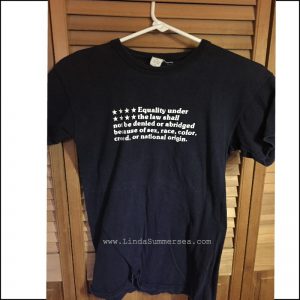
My 1972 E.R.A. t-shirt still hangs in my closet. “Equality of rights under the law shall not be denied or abridged by the United States or by any State on account of sex.”

Not to quibble with our accomplishment in gaining the Equal Rights Amendment, but as Ruth Bader Ginsberg has said:

The Equal Rights Amendment needs to be added to the Constitution, so that “no one” can take it away. Let’s not let anyone get any ideas.


Yes, Sojourner Truth, the flappers like my grandmother who got the 19th amendment passed, and Rosie the Riveter, all came first.

But the 60s is when it all blew up.

As little girls in the 50s, some of us were feeling the stirrings of simple injustices.

“I was clearly a young feminist, even though the word ‘feminist’ was not in my vocabulary. As an elementary student, I always questioned—only in my thoughts, mind you—why the boys were the only ones who got to carry the dark green metal wastebaskets full of trash out to the incinerator on the edge of our schoolyard at 2:45, shortly before the first bell rang the close of our school day.

Our school had a fearsome brick incinerator. A tall smoke stack reached skyward from its concrete top, spreading the remains of our rejected schoolwork high over the town, just like the smoke that rose over the Vatican marking the election of Pope John XXIII after Pius XII died.

I envisioned the representative boys from all of the classrooms, gathering there in the afternoon like a secret society, punching and fooling around as they waited their turn to feed the monster. After emptying their wastebaskets, the boys retraced their steps. They knew precisely how much time they could waste while dawdling in the halls on the return trip, and yet still arrive in time to grab their school bags and lunch boxes and line up with the rest of us.

Even as a Kindergartner, I noticed that only boys got to carry the wooden milk cases from the front hall, where the milkman delivered them, to our classroom where more boys unpacked the milk bottles and stood them on the radiators to warm.

The issue of patrol boys annoyed me even more. I may have been young, but I knew damn well that I was as qualified to usher students across a street as any badged and belted bully boy at St. Mary’s.

Of course, the injustice went both ways. Occasionally someone would misbehave, and guess what? It was always a boy who got his bottom or hand whacked with the stern oak pointer of retribution. Each class had a couple of boys who were marked as troublemakers and were flogged constantly until they escaped to high school.

In eight grade Civics class, we learned there were such things are “congressional pages” who carried messages for the members of Congress in Washington and did other errands. This appealed to me. I looked up the requirements. I only needed a letter of recommendation from my teacher to a state Senator or Representative to accompany my application. Then I found out that girls were not allowed. I was furious. As I tallied the limitations of my sex, I saw that boys clearly had an unfair advantage.

At home, it was no different. The domestic chores went to us girls. I was assigned vacuum duty as soon as I was strong enough to wield a Hoover. Robby never had to lift so much as a duster.

After our baby brother was born and we moved from the farm to our new house on the hill, the chore scales at our house tipped even more in favor of Robby, who was now ten years old. He no longer had to feed the pigs. His chores were reduced to taking out the trash and feeding the dog, and then he went off with his .22 until suppertime.

My sister and I had to vacuum, take our baby brother for stroller rides, change his diapers, put away his toys, prepare his baby bottles, entertain him, put him to bed. In addition that that, I had to cook dinner four nights a week, and do the dishes.

Mummy worked those four nights a week. She passed me the baby as I entered the front door after school and skipped merrily down the steps to drive away in her Jeep. No instructions and no looking back.”

~The Girl with the Black and Blue Doll, Linda Summersea

Later, as a young teacher, I finally was able to afford the orthodontic braces that Daddy said I didn’t need. Imagine my shock when the orthodontist’s office informed me that the procedure would not begin until I brought my new husband’s signature to take responsibility for the payments! In 1974!

If you know me, you already know that I did not bring them my husband’s signature, and I gave them a good talking-to regarding the need to change the financial arrangement requirements on their forms.

Today, thankfully, girls can become congressional pages. They can even grow up to run for President of the United States—although we’re far behind many other countries in acknowledging women as world leaders.

Girls are no longer assumed to be the goody-two-shoes, and boys no longer have to take the blame for every wrong deed.

With equality comes responsibility. Happy International Women’s Day!

#internationalwomensday

international women's day

Follow me on Facebook.

Subscribe to my blog. Thanks!